You’re at a family gathering, and someone casually says, “Oh, Montessori? That’s where kids just play all day and do whatever they want, right?” You smile politely. But inside, something tightens — because you’ve been researching schools for weeks, and now you’re second-guessing yourself all over again.
Choosing a school for your child already feels like carrying the weight of their entire future. When myths and half-truths get thrown into the mix, that weight doubles. You start wondering if you’re being a thoughtful parent or a naive one.
Let me walk you through the most common myths I hear from parents about Montessori schools — and what the reality actually looks like when you step inside one.
The Biggest Misunderstanding: “There Are No Rules”
This is the myth I encounter most often. The idea that Montessori classrooms are chaotic, unstructured places where children wander around doing nothing in particular. It sounds alarming when you hear it. But it’s also deeply inaccurate.
What Montessori actually offers is structured freedom. Children choose their activities — but from a carefully prepared set of options. There are clear ground rules about how materials are used, how you speak to others, and how you care for the shared space. A child who finishes working with a material puts it back exactly where it belongs before choosing something else.
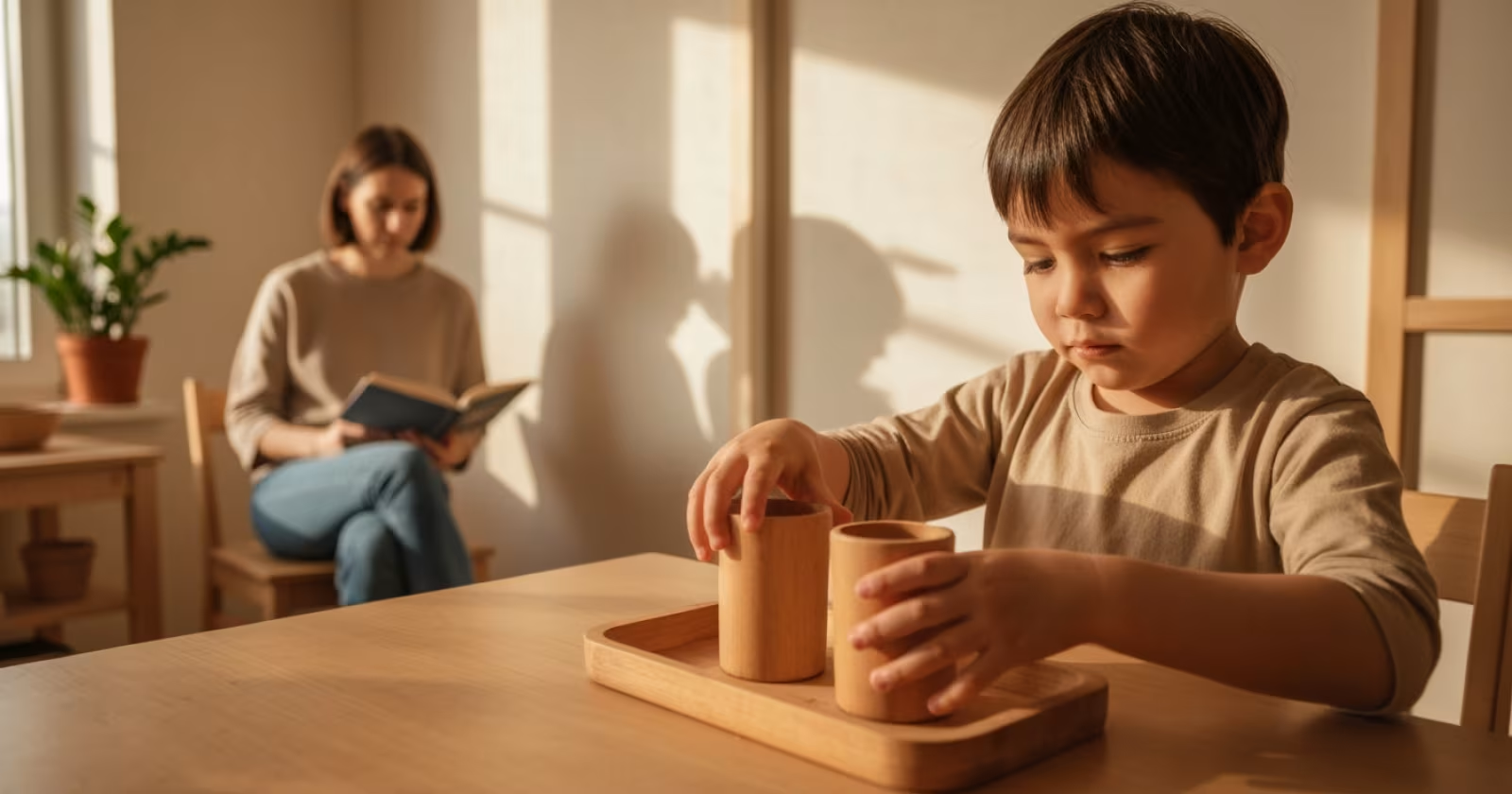
Picture a classroom where a four-year-old is quietly pouring water between two small pitchers, fully focused. Beside her, another child is tracing sandpaper letters. Across the room, a small group is working on a puzzle together. No one is shouting instructions. But every child knows exactly what’s expected of them.
Freedom within limits — that’s the core of Montessori. The child chooses the work, but the environment holds the boundaries.
That’s very different from “no rules.” If anything, Montessori children often develop a stronger internal sense of order precisely because they practice it every single day.
Why These Myths Stick Around
Most of these misunderstandings come from comparing Montessori to the traditional school model we all grew up with. When something looks different from what we know, we fill in the gaps with assumptions. That’s a very human thing to do.
Maria Montessori developed this method over a hundred years ago based on careful observation of how children naturally learn. But because it doesn’t look like rows of desks and a teacher at a blackboard, people assume it must be less rigorous. The truth is — it’s rigorous in a different way.
Here are some of the most persistent myths and what’s really going on:
- “Montessori is only for preschoolers.” The method spans from infancy through adolescence. Many Montessori programs run through elementary and even middle school, adapting the approach for each developmental stage.
- “Children never learn to follow instructions.” They follow instructions constantly — from the materials themselves, from classroom norms, and from the guide (teacher). They simply aren’t drilled with top-down commands all day.
- “It’s only for wealthy families.” While private Montessori schools can be expensive, there are public and subsidized Montessori programs in many cities across India and worldwide. The method itself was originally designed for children from low-income families in Rome.
- “Kids won’t adjust to regular school later.” Research in 2026 continues to show that Montessori-educated children often transition well because they’ve developed strong self-regulation, focus, and social skills.
- “There’s no academic learning — just play.” Montessori children often learn to read, write, and do math earlier than their peers, because the materials are designed to teach these skills through hands-on exploration.
The real reason these myths persist is that Montessori asks us to trust children more than most of us were trusted as kids. That’s uncomfortable. It challenges something deep in how we were raised.
| Common Myth | The Reality |
|---|---|
| No structure or discipline | Structured environment with clear, consistent boundaries |
| Only for toddlers | Programs available from birth through age 18 |
| Children fall behind academically | Many children advance ahead of grade level in literacy and math |
| Too expensive for most families | Public and affordable Montessori options exist globally |
| Kids can’t transition to traditional schools | Strong self-regulation helps children adapt to various settings |
| Teachers don’t teach | Teachers (called guides) observe closely and introduce lessons individually |
How to See Past the Myths and Make a Real Decision
Visit the classroom yourself. No article — including this one — can replace what you’ll feel when you sit in a Montessori classroom for thirty minutes. Watch how the children move. Notice the quiet concentration. Ask yourself if that feeling matches what your child needs.
Talk to the guide, not just the administrator. The teacher (or guide) is the heartbeat of any Montessori classroom. Ask them how they handle a child who refuses to work, or one who only wants to do the same activity every day. Their answers will tell you everything about the quality of that school.
Ask about training and accreditation. Not every school that uses the word “Montessori” follows the method authentically. Look for teachers trained through recognized programs and schools affiliated with established Montessori organizations. This single step filters out most of the confusion.
Watch your child at home for clues. Does your child gravitate toward doing things independently? Do they get frustrated when you take over a task they wanted to finish? Do they love sorting, arranging, and exploring with their hands? These are signs that a Montessori environment might feel like home to them.
Let go of the pressure to decide perfectly. No school — Montessori or otherwise — will be flawless. What matters is whether the core values of the school align with how you want your child to experience learning. That’s a feeling, not a checklist.
One thing I always suggest to hesitant parents: separate what you’ve heard about Montessori from what you’ve seen. Most fears dissolve the moment you observe a real classroom in action.
What Your Child Might Be Gaining That You Can’t Easily Measure
Grades and test scores are easy to point to. But some of the deepest gifts of a Montessori education are harder to quantify — and they show up years later.
Children who learn to choose their own work develop something called intrinsic motivation — the ability to do something because it matters to them, not because someone is watching. This is the skill that drives curiosity long after school ends.
Mixed-age classrooms teach empathy in a way that same-age groups rarely can. A five-year-old who helps a three-year-old with a task isn’t just being kind — they’re deepening their own understanding by teaching it. And the younger child sees a role model who is close enough in age to feel reachable.
These aren’t small things. In a world that increasingly rewards creativity, adaptability, and emotional intelligence, these skills matter more than we sometimes realize.
Parenting is full of decisions that feel enormous in the moment. Choosing a school is one of them. It’s okay to feel uncertain. It’s okay to change your mind later. What matters most is that you’re paying attention — to your child, to your instincts, and to what feels true beneath the noise.
The best school for your child isn’t the one with the best reputation. It’s the one where your child walks in and feels seen.