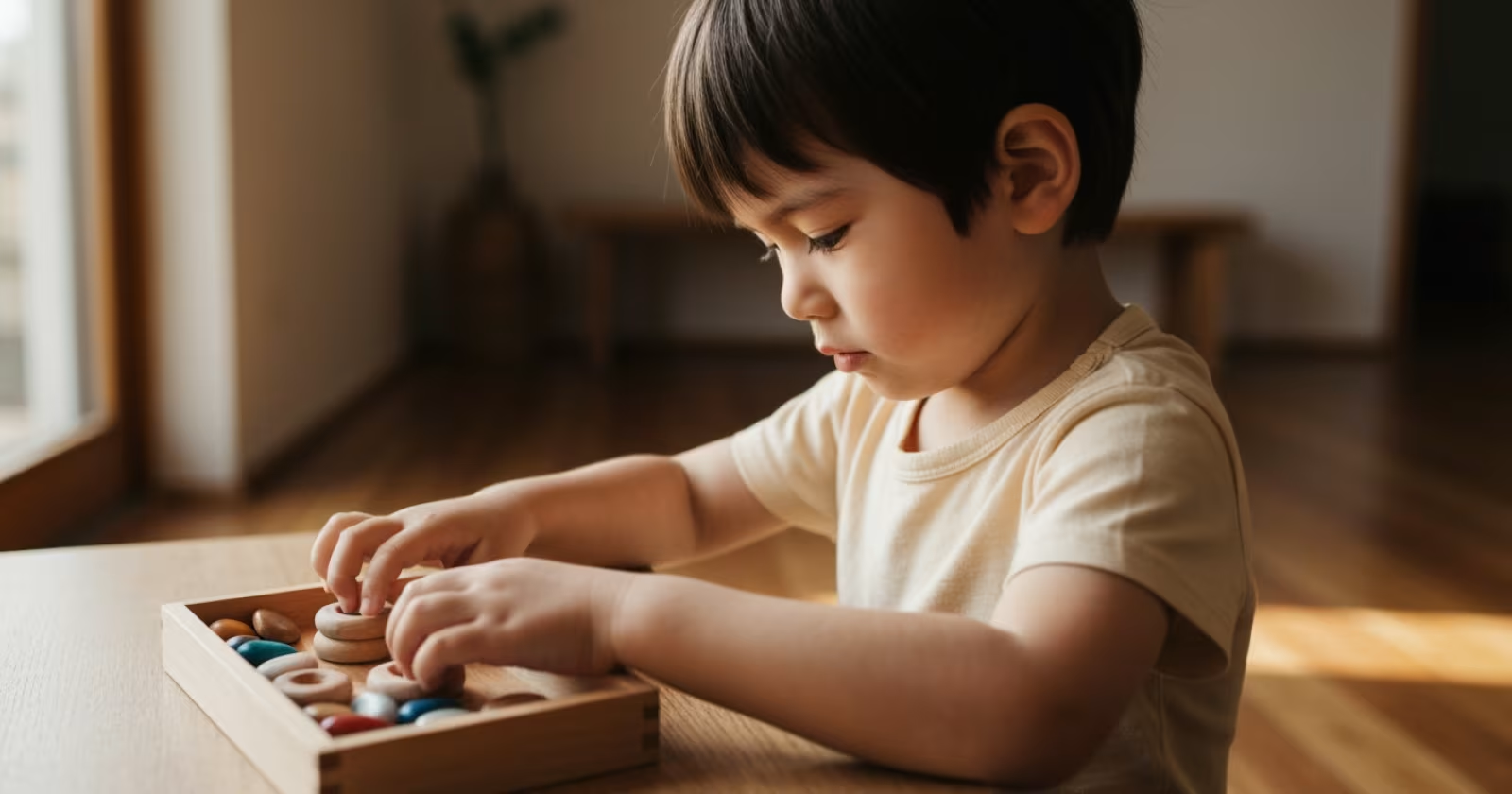
She’s three years old, standing on a small stool, slowly pouring water from a jug into a glass. Half the water spills. She doesn’t cry. She reaches for a cloth, wipes the counter, and tries again. You’re watching from across the kitchen, every muscle in your body wanting to step in and do it for her.
But you don’t. And in that tiny, quiet moment — something extraordinary is happening inside her brain.
This is what Montessori at home actually looks like. Not expensive wooden toys. Not a perfectly organized playroom from a social media post. It’s the invisible work happening behind a child’s eyes when they’re allowed to struggle, choose, and do things at their own pace. And the science behind it is more powerful than most parents realize.
The Brain Doesn’t Just Learn — It Builds Itself
Here’s something that changed how I think about early childhood. A child’s brain isn’t a blank hard drive waiting for us to upload information. It’s a living, growing organ that physically shapes itself based on experience. Every time a child repeats an activity, makes a choice, or solves a small problem — new neural connections form and strengthen.
This is called neuroplasticity. It simply means the brain rewires itself based on what a child does repeatedly. And the Montessori approach, even at home, is designed to trigger exactly this kind of brain-building.
When a child chooses to sort buttons by colour, or carefully spoons lentils from one bowl to another, they aren’t “just playing.” They’re activating the prefrontal cortex — the part of the brain responsible for planning, decision-making, and self-control. This area doesn’t fully develop until the mid-twenties. But the foundations? Those are being laid right now, in your living room.
A child who is allowed to choose, concentrate, and complete a task without interruption is literally building the architecture of their own brain.
Think about what happens in a typical day for a toddler. Someone picks their clothes. Someone hands them food. Someone decides when they play and when they stop. Now imagine a home where a child can pick between two outfits, pour their own milk, and decide whether to draw or build with blocks. The difference isn’t just behavioural. It’s neurological.
Why Montessori Works the Way the Brain Naturally Develops
Maria Montessori observed something over a hundred years ago that neuroscience has only recently confirmed. Children go through what she called “sensitive periods” — windows of time when their brains are especially hungry for certain types of learning. Language. Order. Movement. Small details. Sensory experiences.
When a child is in a sensitive period for order, they may insist on the same bedtime routine every night. When they’re in one for small objects, they’ll pick up every crumb and pebble on the floor. These aren’t annoying habits. They’re signs of a brain that is ready to absorb something specific.
Montessori at home means recognizing these windows and responding to them — not with flashcards or structured lessons, but with the right environment and the right freedom.
- A child obsessed with opening and closing things is developing hand strength and problem-solving — give them containers with different lids.
- A child who wants to help in the kitchen is in a sensitive period for practical life skills — let them wash vegetables or tear lettuce.
- A child who lines up toys in rows is craving order — this is their brain organizing the world, not a cause for concern.
- A child who repeats the same puzzle fifteen times is strengthening neural pathways through repetition — resist the urge to redirect them.
The brain develops best not when we push learning from outside, but when we create conditions for the child to pull learning from within. This is the core of how Montessori works with the brain, not against it.
What Changes Inside Your Child When You Practice This Daily
You don’t need a Montessori school. You don’t need certification. You need a shift in how you see your child’s everyday moments. Here’s what research in developmental neuroscience tells us actually changes in a child’s brain when key Montessori principles are practised consistently at home.
| Montessori Practice at Home | What Happens in the Brain |
|---|---|
| Letting the child choose activities | Strengthens decision-making pathways in the prefrontal cortex |
| Allowing uninterrupted concentration | Builds sustained attention and deep focus circuits |
| Encouraging real-life tasks (pouring, sweeping) | Develops motor planning and hand-brain coordination |
| Offering freedom within limits | Supports self-regulation and impulse control |
| Reducing screen time and overstimulation | Protects dopamine balance and attention span |
| Responding calmly to mistakes | Reduces cortisol (stress hormone) and builds emotional resilience |
The cumulative effect of these small daily practices is what researchers call strong executive function. Executive function is a set of mental skills that includes working memory, flexible thinking, and self-control. Children with strong executive function do better in school, in friendships, and in managing their own emotions — not because they were drilled, but because their brains were allowed to develop naturally.
Simple Ways to Start Without Overhauling Your Home
You don’t need to buy a single thing. Start with what you already have and how you already interact with your child.
Slow down your help. When your child is struggling with a zipper or a button, wait ten seconds before stepping in. Those ten seconds are brain-building seconds. Count silently if you need to. Your patience is the most powerful Montessori material in the house.
Offer two choices instead of commands. Instead of “Wear this shirt,” try “Do you want the blue shirt or the green one?” This tiny shift activates the decision-making part of the brain and reduces power struggles at the same time.
Create a yes-space in one corner. A low shelf with three or four activities your child can reach independently. Rotate them every week or two. When children can access materials without asking, they learn to self-direct — a skill that serves them for life.
Protect their concentration. If your child is deeply focused on something — even if it looks pointless to you — don’t interrupt with praise, questions, or redirection. Deep focus is rare and precious. Guard it.
Let them do real work. Folding a napkin. Watering a plant. Cracking an egg. Real tasks give a child a sense of purpose that no toy can replicate. Their brain registers the difference between pretend work and real contribution.
None of these require perfection. Some days you’ll rush through the morning and zip up the jacket yourself. That’s fine. What matters is the overall direction, not every single moment.
Parenting is not about getting it right all the time. It’s about understanding what your child’s brain actually needs — and finding small, honest ways to offer that amidst the beautiful mess of everyday life.
The next time your child insists on doing something “by myself,” take a breath. Step back. Let them struggle a little. What looks like slowness on the outside is growth on the inside — quiet, powerful, and entirely their own.