She was barely four, sitting on the floor with a set of wooden beads, completely absorbed. No one told her to sit there. No one gave her a timer or a sticker chart. She just chose it — and stayed with it for twenty minutes straight.
Her mother stood at the classroom door, stunned. At home, this child couldn’t sit still for five minutes. Yet here, something was different. The room was calm. The children moved freely. And her daughter looked genuinely peaceful.
If you’ve ever wondered whether Montessori is just a trendy label or something deeper, this is worth reading — because the research tells a story that might change how you think about how children learn.
It’s Not About the Materials — It’s About How the Brain Learns
When most people hear “Montessori,” they picture wooden toys and child-sized furniture. But the real heart of this approach is something far less visible. It’s about trusting children to follow their own curiosity — and building an environment that supports that trust.
Maria Montessori, the Italian physician who developed this method over a century ago, observed something powerful. Children don’t need to be forced to learn. They are wired to learn. What they need is the right environment and the freedom to explore it at their own pace.
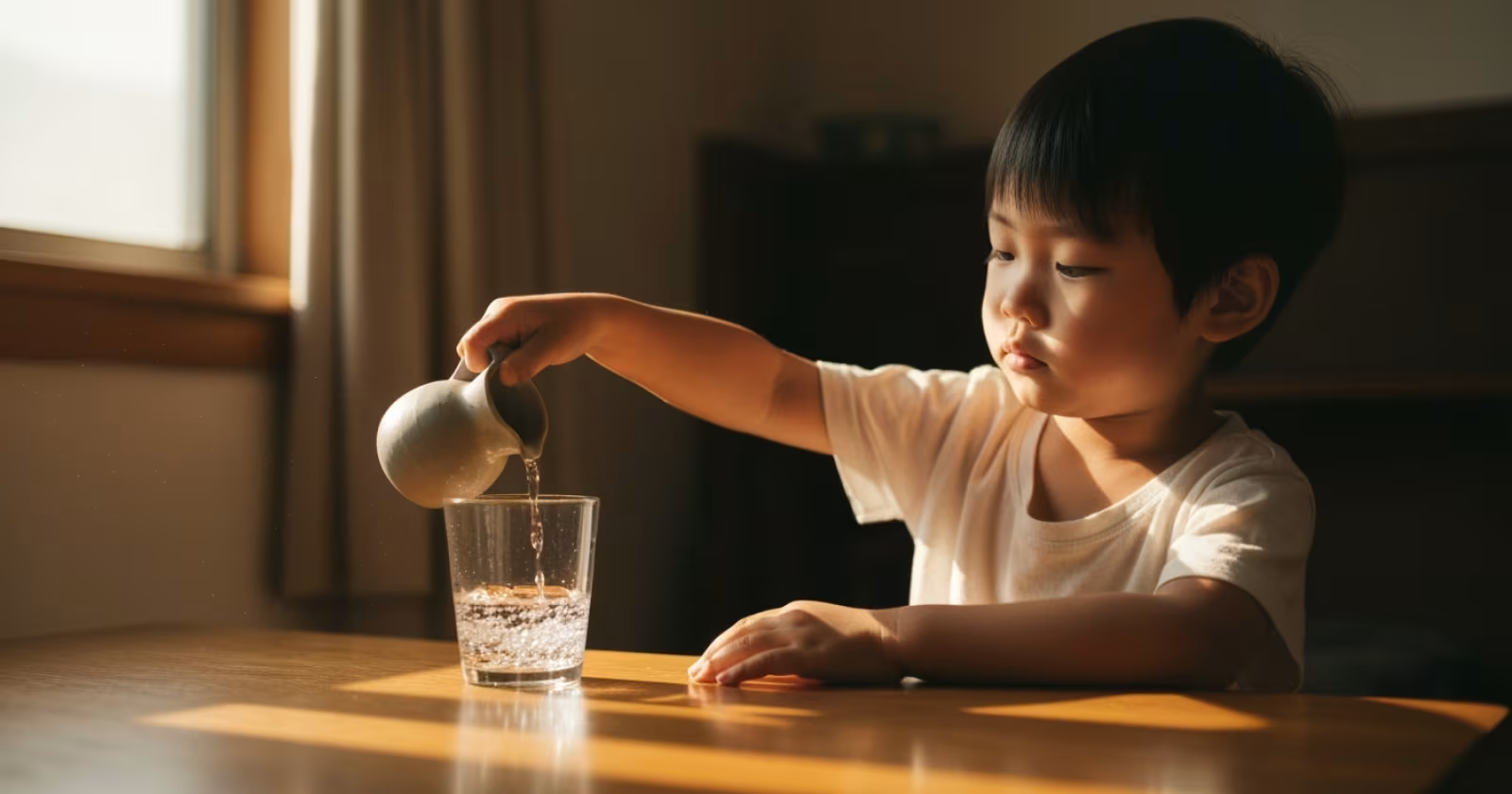
A child in a Montessori classroom might spend thirty minutes pouring water between containers. To an adult, it looks like play. But that child is building concentration, hand-eye coordination, and a sense of order — all without being told what to do or how to do it.
When a child chooses their own work and stays with it, they aren’t just learning a skill — they are learning how to learn.
This is the core idea that separates Montessori from conventional education. And it’s exactly what modern research in child development keeps confirming.
What the Research Actually Shows
Over the past two decades, several well-designed studies have compared Montessori-educated children with their peers in traditional settings. The findings are consistent and compelling.
One landmark study published in the journal Science found that children in Montessori programs showed stronger gains in reading and math by age five — but also in social skills and executive function. Executive function is the brain’s ability to plan, focus, and manage impulses. Think of it as the “self-control muscle” that helps children navigate life, not just school.
Other research has shown that Montessori children tend to develop stronger intrinsic motivation. That means they want to learn for the sake of learning — not because someone promised them a reward. This matters deeply, because intrinsic motivation is one of the strongest predictors of long-term academic and personal success.
Here’s a snapshot of what research consistently highlights:
- Stronger reading and math outcomes in early childhood compared to traditional preschools
- Better social problem-solving skills and a greater sense of fairness among peers
- Higher levels of creativity and willingness to take on challenging tasks
- Greater ability to focus and sustain attention without external prompts
- More positive feelings about school and learning overall
| Area of Development | Traditional Setting | Montessori Setting |
|---|---|---|
| Motivation Type | Often extrinsic (rewards, grades) | Primarily intrinsic (curiosity-driven) |
| Social Skills | Peer-age interaction mostly | Mixed-age collaboration and mentoring |
| Learning Pace | Teacher-directed, uniform | Child-led, individualized |
| Focus and Attention | Structured by schedule | Built through long, uninterrupted work periods |
| Error Correction | Teacher gives feedback | Materials are self-correcting |
| Creativity | Variable, often limited by curriculum | Encouraged through open-ended exploration |
What stands out is that the benefits aren’t limited to academics. They touch every part of who a child is becoming — emotionally, socially, and cognitively.
Why Montessori Works the Way It Does
The method aligns closely with what neuroscience now tells us about how young brains develop. Children’s brains grow best through hands-on, sensory-rich experiences — not passive listening. Montessori classrooms are built around exactly this principle.
Maria Montessori identified what she called “sensitive periods” — windows of time when a child’s brain is especially ready to absorb certain skills. Language, movement, order, sensory refinement — each has its window. Montessori classrooms are designed to meet children right where these windows open.
The mixed-age classroom is another quietly powerful element. When a five-year-old helps a three-year-old tie their shoes, both children benefit. The older child strengthens their understanding by teaching. The younger child feels safe learning from someone close to their own world. This is not a strategy someone invented in a lab. It mirrors how children have learned in families and communities for thousands of years.
And then there’s the concept of the “prepared environment.” Everything in a Montessori classroom has a purpose and a place. Children know where things belong. They return materials when they’re done. This sense of order isn’t rigid — it’s calming. It gives children a feeling of control in a world that often feels overwhelming to them.
How Parents Can Bring These Principles Home
You don’t need to enroll your child in a Montessori school to apply what works. Many of these ideas can live in your home, starting today.
Create a “yes” space. Set up one area in your home where your child can freely explore without hearing “no” or “don’t touch.” Stock it with simple, open-ended materials — measuring cups, fabric scraps, crayons, a small pitcher of water. Let them choose what to do.
Resist the urge to interrupt focus. When your child is deeply absorbed in something — even if it looks pointless to you — protect that moment. Don’t call them away for a snack or a photo. Deep concentration is a skill that takes years to build, and every interruption chips away at it.
Let them struggle a little. When your child is trying to button their shirt or stack blocks that keep falling, wait before jumping in. That slight frustration is where real learning happens. Offer help only when they ask — or when frustration turns to distress.
Slow down your language. Instead of saying “Good job,” try describing what you see. “You used three different colors in that drawing.” Instead of “Be careful,” try “Notice how the step is wet.” This kind of language builds awareness, not dependence on praise.
Involve them in real life. Let your child help with cooking, cleaning, folding laundry. Not as a chore — but as something meaningful. Children desperately want to feel useful. When we let them participate in real work, we honor that need.
A Gentle Word About Choosing What’s Right
No single educational approach is perfect for every child or every family. Montessori works beautifully for many children, but it’s not the only path to raising a thoughtful, capable human being. What matters most is not the label on the school building. It’s whether the adults around your child — at school and at home — truly see them, respect their pace, and trust their ability to grow.
Parenting is full of decisions that feel enormous. Which school. Which method. Which book to believe. Some of those decisions matter less than we think — and some matter more than we realize.
The one that almost always matters is this: did your child feel respected today — not just loved, but genuinely respected as a person who is already becoming someone.