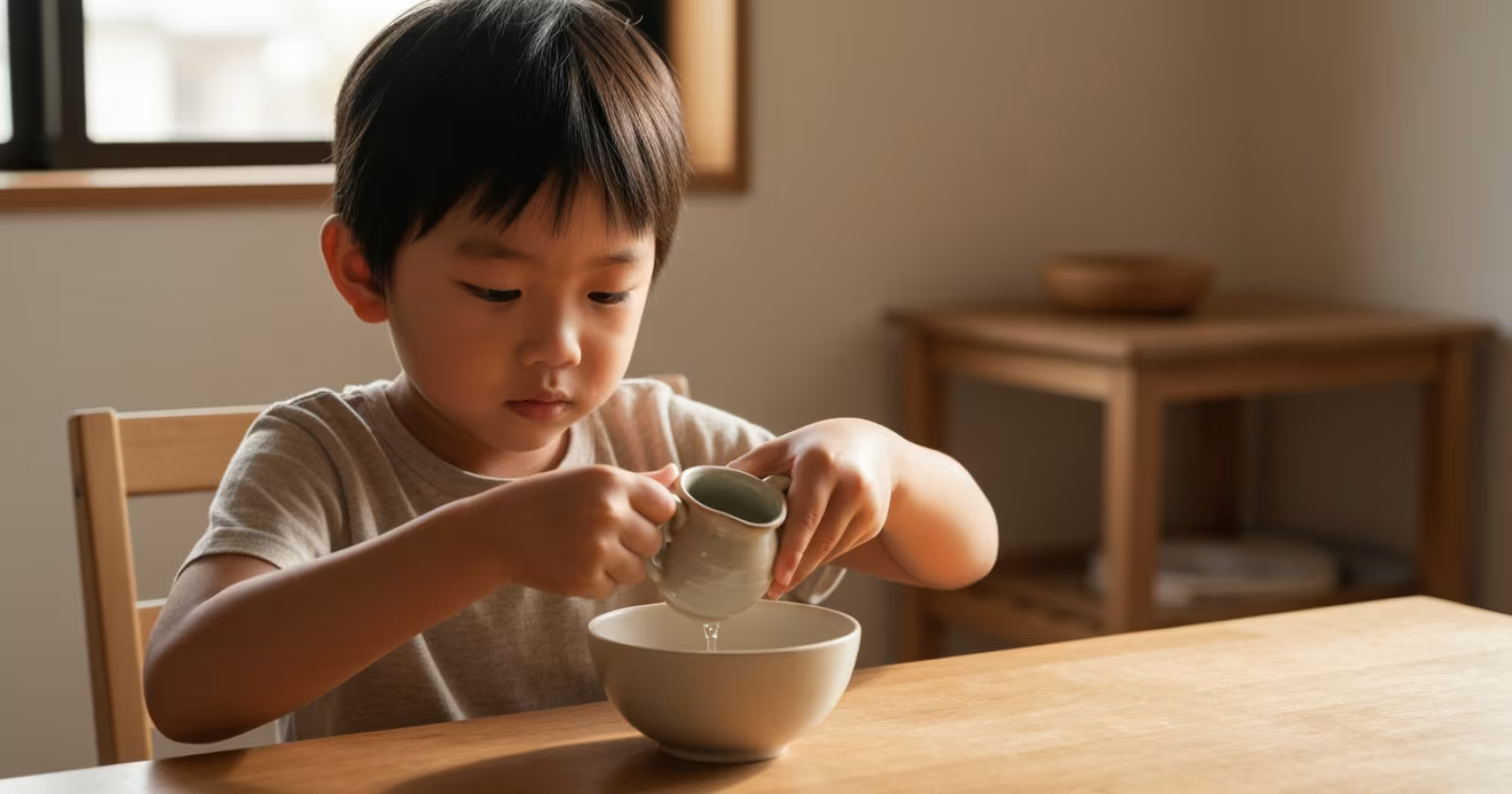
She was sitting on a tiny chair, watching. Not correcting. Not lecturing. Just watching a four-year-old struggle — and then figure out — how to pour water from a jug into a glass without spilling it.
The child spilled some. Paused. Tried again. Got it right. And the look on that little face was something no gold star or “good job” could ever replicate. That quiet woman on the tiny chair? She was doing some of the hardest teaching work there is — by choosing not to intervene.
If you’ve ever wondered what makes a Montessori classroom feel so different from a traditional one, the answer starts right here — with what the adult in the room is actually doing.
The Adult in the Room Plays a Very Different Role
In most classrooms we grew up in, the teacher stood at the front. She talked. We listened. She asked questions. We raised hands. The knowledge flowed in one direction — from adult to child. And for most of us, that felt completely normal.
In a Montessori setting, the adult is not called a “teacher” in the traditional sense. Maria Montessori used the word “directress” — someone who directs the child’s attention toward the environment, not toward herself. In 2026, many Montessori schools simply call this person a “guide.”
The difference is not just a label. It reflects a completely different belief about how children learn. A traditional teacher delivers information. A Montessori guide creates the conditions for a child to discover it.
The goal is not to make the child dependent on the adult for answers — but to help the child trust their own ability to find them.
Think of a parent at home who always ties their child’s shoelaces because it’s faster. Now think of a parent who sits patiently, letting the child fumble, offering a small hint only when frustration peaks. Both love their child. But one is building a skill — and a sense of self — that the other isn’t.
Why This Approach Works With How Children Actually Develop
Children under six are in what Maria Montessori called “sensitive periods” — windows of time when their brains are wired to absorb certain skills almost effortlessly. Language, movement, order, sensory experiences — these aren’t things you need to force-teach. Children are already reaching for them.
A Montessori guide’s job is to notice which sensitive period a child is in and then offer the right materials at the right time. This is why observation is the most important skill a Montessori guide develops. Not lesson planning. Not crowd control. Observation.
Here are some key ways a Montessori guide’s role differs from a traditional teacher’s approach:
- The guide follows the child’s interest rather than a fixed syllabus for the whole class.
- Lessons are given one-on-one or in small groups, not broadcast to thirty children at once.
- The guide prepares the environment — the materials, the layout, the rhythm of the day — so the space itself teaches.
- Mistakes are treated as part of learning, not something to be marked wrong.
- The guide steps back when a child is engaged and steps in only when genuinely needed.
This doesn’t mean the Montessori classroom is chaotic or unstructured. It’s actually deeply structured — but the structure lives in the environment, not in the adult’s control over the children.
| Aspect | Traditional Teacher | Montessori Guide |
|---|---|---|
| Primary role | Delivers knowledge | Prepares environment and observes |
| Lesson style | Whole-class instruction | Individual or small-group presentations |
| Curriculum pace | Same for all children | Follows each child’s readiness |
| Discipline approach | External rewards and consequences | Internal motivation and natural consequences |
| Error correction | Teacher corrects the child | Materials are self-correcting |
| Child’s movement | Seated at assigned desk | Free to move and choose work area |
| Assessment | Tests and grades | Ongoing observation and documentation |
What This Means for Your Child — and for You as a Parent
If your child is in a Montessori school, you might sometimes wonder: “Is the teacher actually teaching?” It can look so different from what we expect that it feels passive. But what’s happening underneath is deeply intentional.
The guide has spent hours preparing those shelves. Each material is placed at the child’s height, in a specific order, designed to isolate one concept at a time. When the guide gives a lesson, it’s brief — sometimes just two or three minutes — and then the child is free to practice independently, as many times as they want.
This builds something that no amount of homework can build: intrinsic motivation. The child works because the work itself is satisfying, not because someone is watching or grading.
You can bring pieces of this philosophy into your home, even if your child attends a traditional school:
- Pause before helping. When your child struggles with something — a puzzle, a zipper, a math problem — count to ten silently before stepping in. Often, they’ll figure it out in that window.
- Offer choices, not instructions. Instead of “Do your homework now,” try “Would you like to start with reading or math?” This small shift gives the child ownership.
- Prepare the space. Keep your child’s books, art supplies, and clothes at their height. When children can access what they need independently, they practice independence dozens of times a day without you saying a word.
- Observe before you react. If your child is doing something that puzzles you — lining up toys, pouring water back and forth, repeating the same action — watch a little longer. They may be practicing a skill their brain is hungry for.
- Reduce praise, increase acknowledgment. Instead of “Good job,” try describing what you see: “You poured the whole glass without spilling.” This helps the child notice their own achievement rather than performing for your approval.
None of this means traditional teaching is wrong. Many wonderful teachers in conventional schools naturally do some of these things. The distinction isn’t about good versus bad. It’s about understanding two very different philosophies of what a child needs from the adult in the room.
The Hardest Part of Being a Guide
Here’s something most people don’t talk about. The hardest part of the Montessori approach — whether you’re a trained guide or a parent at home — is restraint. It is genuinely difficult to watch a child struggle and not rush in.
We step in because we love them. We correct because we want them to get it right. We hurry them because the world is hurrying us. None of that makes us bad parents or bad teachers. It makes us human.
But when we practice stepping back — even a little, even imperfectly — we send a quiet message that echoes louder than any lesson: I believe you can do this.
And children who receive that message, over and over, begin to believe it about themselves. That belief becomes the foundation for everything else — confidence, resilience, the courage to try hard things.
You don’t need a Montessori classroom to give your child that gift. You just need a few more seconds of patience than feels comfortable. The learning often lives in that pause.