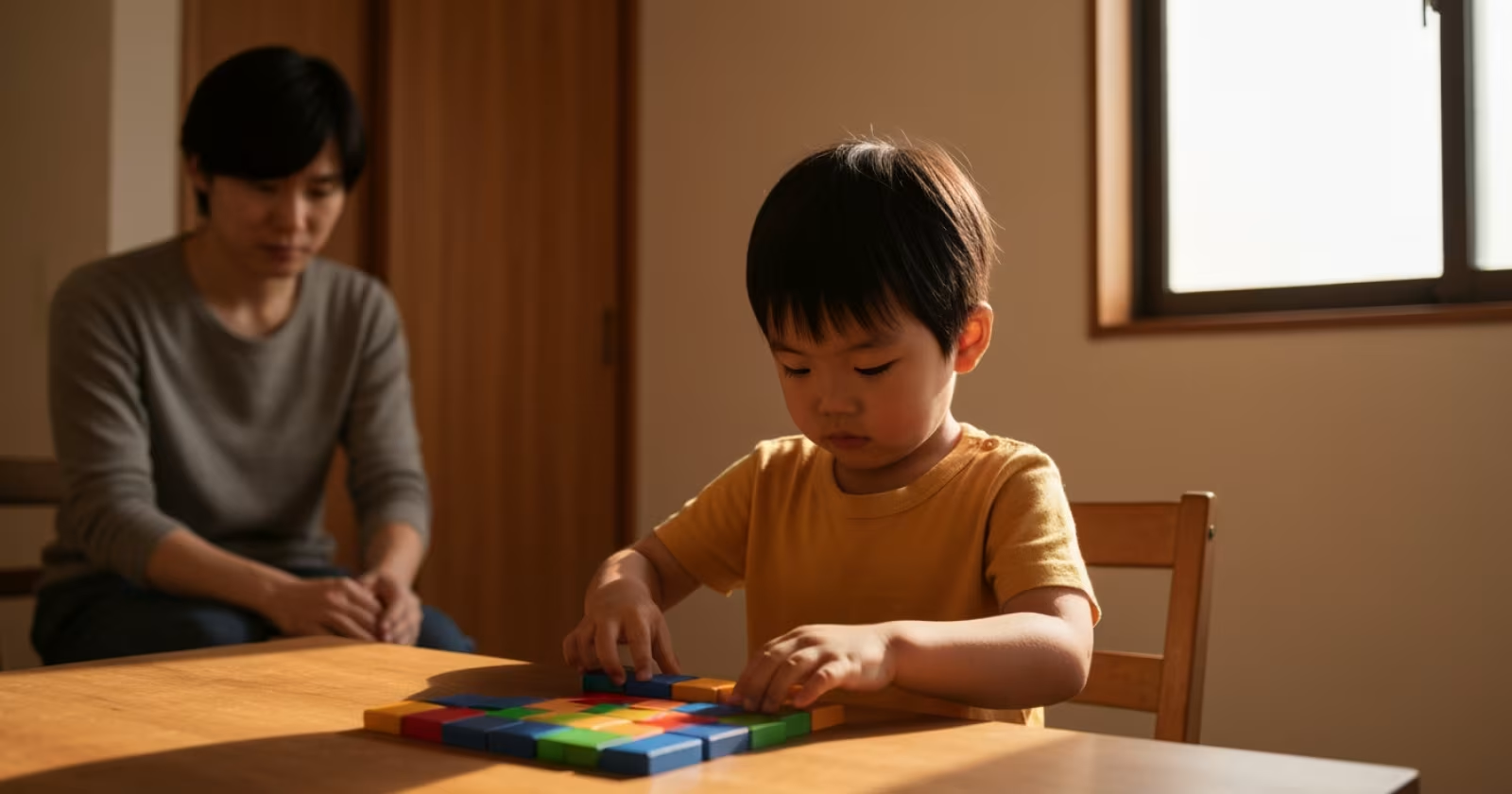
Your three-year-old is pouring water from a small jug into a cup. It spills. She pours again. It spills less this time. You want to step in and do it for her, but something tells you to wait. On the fourth try, the water lands perfectly in the cup — and the look on her face is pure, quiet pride.
That moment — the waiting, the trusting, the letting her figure it out — is closer to Montessori than any expensive toy or fancy classroom. And yet, for most of us, the word “Montessori” feels wrapped in mystery. Is it a type of school? A parenting style? Something only wealthy families can afford?
Let me break it down in a way that actually makes sense. Because once you understand what Montessori really is, you will start seeing your child — and your role — a little differently.
It Started with One Woman Watching Children Very Carefully
Maria Montessori was an Italian doctor born in 1870. She was one of the first female physicians in Italy. But her real gift was not medicine — it was observation. She spent years simply watching how children learn when adults stop controlling every moment.
What she noticed changed everything. Children don’t need to be forced to learn. They are already wired to explore, touch, repeat, and master things — if the environment supports them. A child stacking blocks is not “just playing.” She is learning about gravity, balance, sequence, and patience all at once.
Montessori built an entire educational approach around this one truth: children are naturally driven to learn. Our job is not to push them. Our job is to prepare the space, offer the right tools, and then step back enough to let them lead.
The child who concentrates is immensely happy — not because someone praised them, but because the work itself felt meaningful.
This is what Montessori understood before modern neuroscience confirmed it. When children choose their own activity and work at their own pace, their brains light up in ways that forced instruction simply cannot replicate.
The Core Ideas Behind Montessori — Without the Jargon
Montessori can sound complicated when people use terms like “sensitive periods” and “prepared environment.” But the ideas are beautifully simple once you strip away the academic language.
Here are the key principles that shape the Montessori approach:
- Follow the child. Watch what your child is drawn to. If she is obsessed with opening and closing boxes, she is developing fine motor skills and problem-solving. Don’t redirect her — support the interest.
- Sensitive periods are real. Children go through windows of time when they are especially hungry to learn specific things — language, order, movement, small objects. These windows open and close naturally. Montessori designed activities to match these phases.
- The environment matters more than the lesson. A calm, organized space with child-sized furniture and accessible materials invites independence. A cluttered, chaotic room overwhelms the brain and makes focus harder.
- Hands-on learning comes first. Young children learn through touch and movement, not lectures. Pouring rice, buttoning a shirt, washing a table — these “practical life” activities build concentration, coordination, and confidence.
- Freedom within limits. Children get choices — but within a clear, safe structure. You can choose which activity to work on, but you cannot throw the materials across the room. Freedom does not mean no boundaries.
| Montessori Principle | What It Looks Like at Home | Age Range |
|---|---|---|
| Follow the child | Letting your toddler spend 20 minutes transferring beans between bowls | 1–3 years |
| Prepared environment | Low shelves with a few toys, rotated weekly | All ages |
| Practical life skills | Child helps fold small towels or peel a banana | 2–5 years |
| Sensitive periods | Offering lots of language-rich conversation during the language explosion phase | 1–4 years |
| Freedom within limits | “You can paint at the table or draw on the floor — you choose” | 2–6 years |
Notice something? None of this requires a special school or expensive materials. These are ways of seeing your child and responding to what they need — not what we assume they need.
Why This Approach Feels So Different from What We Grew Up With
Most of us were raised in environments where adults decided everything. What to study, when to play, how long to sit still. We were rewarded for obedience and punished for curiosity that went “off track.”
Montessori flips that script. It trusts the child’s inner drive. And honestly, that can feel uncomfortable at first. We are so used to managing children that watching them struggle — and not jumping in — feels almost wrong.
But here is what child development research in 2026 continues to confirm. Children who are given age-appropriate autonomy develop stronger executive function skills. Executive function is just a fancy way of saying the ability to plan, focus, remember instructions, and manage impulses. These are the skills that matter most for school, friendships, and eventually adult life.
When a four-year-old chooses to work on a puzzle for thirty minutes instead of being told to, something powerful happens inside her brain. She is building intrinsic motivation — the desire to do something because it feels satisfying, not because someone will give her a sticker.
That kind of motivation does not fade after childhood. It becomes the foundation of lifelong learning.
Simple Ways to Bring Montessori Thinking into Your Home
You do not need to transform your house overnight. Small shifts make a real difference.
Create one small space that belongs to your child. It could be a low shelf in the living room with four or five activities. Rotate them every week or two. Fewer choices actually help children focus better than a room overflowing with toys.
Slow down your helping hands. When your child is struggling with a zipper or trying to put on shoes, pause. Count to ten silently. Often, they will figure it out — and the pride they feel is worth more than the two minutes you saved.
Invite them into real work. Let your child help in the kitchen — washing vegetables, stirring batter, setting the table. Use real tools sized for small hands when possible. Children crave being useful. It is not a chore to them. It is meaningful participation in family life.
Observe before you direct. Before suggesting an activity, spend five minutes just watching what your child gravitates toward. You might be surprised. The child you thought was “not interested in reading” may actually be fascinated by letters on cereal boxes — she just needs a different entry point.
Respect concentration. If your child is deeply absorbed in something — even if it looks pointless to you — protect that focus. Do not interrupt to offer a snack or redirect to something “more educational.” Deep concentration is the most educational thing a young brain can practice.
These are not rules. They are invitations to try a gentler way of guiding your child — one that trusts their intelligence and respects their pace.
Montessori is not about being a perfect parent. Maria Montessori herself never claimed perfection. She simply asked adults to look at children more carefully — and to believe what they saw.
You do not need to get it right every time. Some days you will jump in too fast. Some days you will lose patience. That is okay. What matters is the intention behind it — the quiet decision to see your child as a capable human being, not a project to manage.
The most Montessori thing you can do today costs nothing. Just watch your child for ten uninterrupted minutes — and notice what they are already trying to teach you.