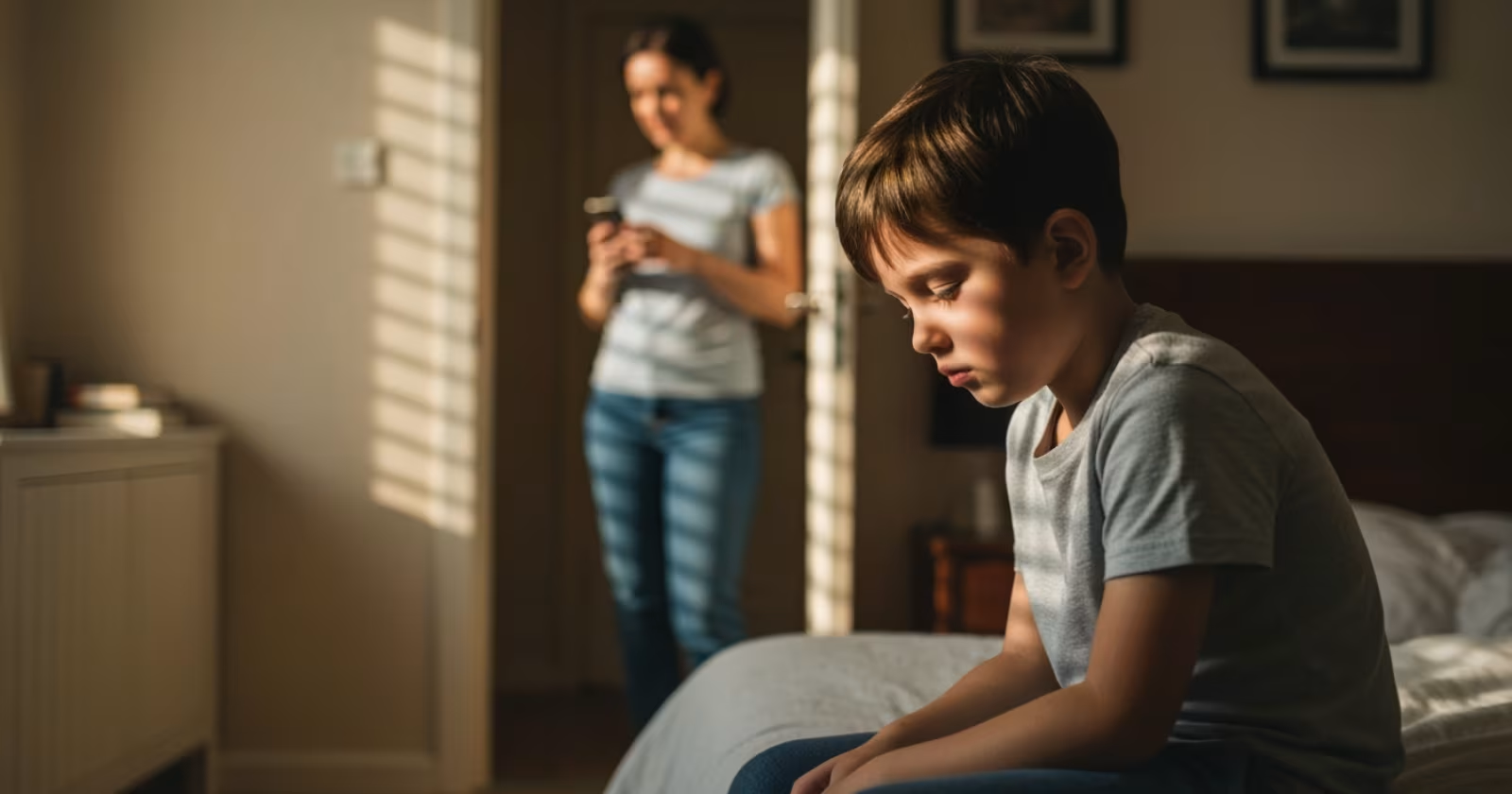
There was a time when the questions never stopped. In the car. At dinner. Right before bed, when you were already half-asleep. “Why is the moon following us?” “What happens when fish sleep?” “Why do you go to work if you don’t like it?” One question after another, sometimes three in a single breath.
And then, one day — quiet. Not the peaceful kind. The kind that sits heavy in a room. The kind where your child looks at something with clear wonder in their eyes but says nothing. They just look away.
That silence can feel sudden. But it almost never is. Something shifted between the asking and the not-asking. And understanding what happened there is one of the most meaningful things we can do as parents.
The Silence Isn’t Empty — It’s Full of Something They Can’t Say
When a naturally curious child stops asking questions, most parents assume it’s just a phase. Maybe they’re growing up. Maybe school is keeping them busy. But more often than not, the child didn’t lose their curiosity. They lost their confidence that curiosity is welcome.
Think about a child who asks why a family member looks different, or why their parents are fighting, or why their teacher said something confusing. If the response they got — even once — was a sharp “Don’t ask that,” or an embarrassed laugh, or a dismissive “You’ll understand when you’re older,” something registers deep inside them. Not as a lesson. As a feeling. The feeling that asking was wrong.
Children don’t process rejection the way adults do. They don’t think, “Oh, that was just bad timing.” They think, “I shouldn’t have said that. Something about me was wrong.”
A child doesn’t stop asking questions because they run out of curiosity. They stop because, somewhere along the way, they learned that asking made them feel small.
That one moment — a sigh, a correction, a look of irritation — can become a turning point. Not because the parent meant harm. But because the child felt it in a way that stuck.
What Actually Happens Inside a Child’s Mind
Children between the ages of 4 and 9 are in what developmental psychologists call the “peak curiosity window.” Their brains are wired to question everything. It’s not annoying behavior — it’s literally how they build their understanding of the world. Every question is a small act of trust. They are saying, “I believe you will help me make sense of this.”
When that trust gets bruised — even unintentionally — the brain starts doing something protective. It begins to associate asking with emotional risk. This is called a shame response, and in children, it develops faster than most parents realize.
Here are some common reasons a curious child may go quiet:
- They were corrected or laughed at for a question in front of others — at home or in school.
- They sensed a parent’s stress or impatience and decided their questions were a burden.
- A teacher or older sibling made them feel their question was “silly” or “obvious.”
- They asked about something emotionally heavy — death, conflict, money — and the adult’s discomfort was visible.
- They started comparing themselves to peers who seemed to already “know” things, and felt behind.
None of these require a dramatic event. Children are extraordinarily sensitive to emotional signals. A parent checking their phone while half-answering, or saying “not now” four days in a row — that’s enough. The child doesn’t hear “not now.” They hear “not you.”
| What the Parent Says or Does | What the Child May Feel Inside |
|---|---|
| “Stop asking so many questions.” | “My curiosity is annoying.” |
| Laughs at a question in front of others | “I’m stupid for not knowing.” |
| Gives a distracted, half-hearted answer | “What I care about doesn’t matter.” |
| “You’re too young to understand.” | “I’m not smart enough yet.” |
| Shows visible discomfort at a tough question | “I asked something dangerous.” |
This table isn’t meant to make anyone feel guilty. I share it because once you see the gap between intention and impact, you can start to close it. And that changes everything.
How to Gently Bring Back the Questions
The good news is that curiosity doesn’t die. It hides. And a child who feels safe again will slowly begin to peek out from behind that wall of silence. But it takes patience, and it takes some very specific shifts in how we respond.
First, start asking them questions — but not the testing kind. Not “What did you learn today?” Try instead: “What’s something that confused you today?” or “Did anything make you laugh?” These kinds of questions show your child that not-knowing is normal, and that wondering about things is something you value.
Second, when they do ask something — anything — protect that moment. Even if you’re tired. Even if the question seems random. Put your phone down. Look at them. Say, “That’s a really interesting thing to wonder about.” You don’t even need to know the answer. Saying “I don’t know — let’s figure it out together” is one of the most powerful things a parent can say.
Third, normalize “silly” questions at home. Share your own. Say things like, “I was wondering today why the sky looks more orange some evenings.” When children see adults being openly curious without embarrassment, it gives them permission to do the same.
Fourth, if your child asked something in the past and you reacted poorly — it’s okay to go back. You can say, “Remember when you asked me about that? I didn’t answer well. I want to try again.” Children are remarkably forgiving when they feel a parent is being honest.
Fifth, talk to their teachers. If the silence started around the time school began or after a class incident, a gentle conversation with the teacher can reveal a lot. Sometimes a single moment in a classroom — being told their question was “off-topic” — is all it takes.
When the Silence Runs Deeper
Sometimes a child’s silence isn’t just about curiosity. It can be a sign of anxiety, emotional overwhelm, or something happening in their social world that they don’t have words for yet. If your child has not only stopped asking questions but has also become withdrawn, avoids eye contact, or seems flat in their emotions, it may be worth speaking with a child psychologist — not because something is “wrong” with your child, but because they may need a safe space outside the family to find their voice again.
There’s no shame in seeking that help. It’s actually one of the bravest things a parent can do — admitting that love alone isn’t always enough, and that your child deserves every kind of support available.
I think about this a lot — how the loudest, most curious children can become the quietest almost overnight, and how the adults around them often don’t notice until much later. We celebrate when kids are “well-behaved” and quiet. We rarely stop to ask what the quiet is costing them.
Parenting doesn’t ask us to be perfect. It asks us to pay attention. And sometimes, the most important thing we can hear from our child is the question they’re no longer asking.
Tonight, if your child is sitting quietly, try sitting next to them. Don’t fill the silence with instructions or lessons. Just be there. And when they’re ready — if you’ve made it safe enough — the questions will come back. Maybe not all at once. Maybe just one, small and tentative, like a hand reaching out to see if yours is still there.