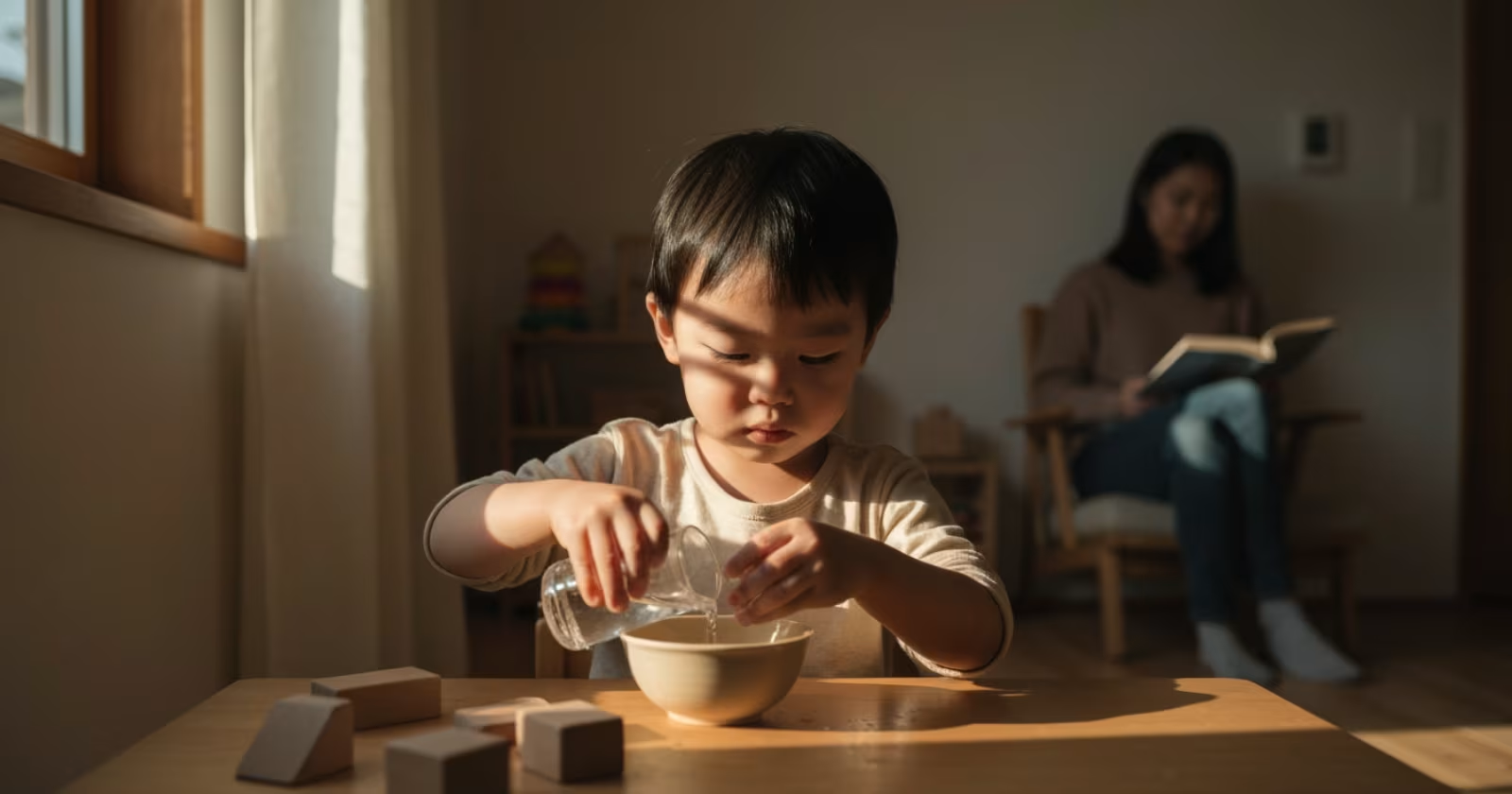
She lined up her tiny shoes by the door, picked up a small jug, and poured water into her glass — slowly, carefully, with both hands steady. She was three. And nobody asked her to do it.
If you’ve ever watched a young child concentrate so deeply on a simple task that the world around them disappears, you’ve already seen the heart of Montessori at work. It’s not magic. It’s not gifted behaviour. It’s what happens when children are given the right activities at the right time.
But when parents hear “Montessori curriculum,” it can feel overwhelming. Five areas, special materials, sensitive periods — where do you even begin? Let me walk you through it the way I wish someone had walked me through it. Simply, honestly, and without the jargon.
The Big Idea Behind Montessori — And Why It Feels Different
Maria Montessori, an Italian physician who spent decades observing children, noticed something powerful. Children between ages 2 and 6 have what she called an “absorbent mind.” They don’t learn the way adults do — by studying and memorising. They absorb everything around them, effortlessly, the way a sponge soaks up water.
This means the environment matters more than the lesson plan. A Montessori classroom — or a Montessori-inspired home — is designed so that a child can choose meaningful work, do it independently, and learn through their hands, not just their ears.
Think of a four-year-old buttoning his own shirt. He’s not just getting dressed. He’s building fine motor control, practising sequencing, developing concentration, and growing his confidence — all at once. That single activity touches multiple areas of development.
In Montessori, the goal is never to keep a child busy. The goal is to let them do real, purposeful work that matches what their brain is hungry to learn right now.
This is what makes Montessori feel different from traditional preschool. There are no gold stars. No worksheets for two-year-olds. Instead, there’s a carefully designed set of activities across five key areas — and each one serves a deep developmental purpose.
The Five Areas of the Montessori Curriculum — And Why Each One Matters
The Montessori curriculum for ages 2 to 6 is divided into five interconnected areas. They aren’t taught in isolation. A child might move between all five in a single morning. But understanding each area helps you see the full picture of what your child is learning — even when it looks like “just playing.”
| Curriculum Area | What It Develops | Examples of Activities |
|---|---|---|
| Practical Life | Independence, coordination, concentration | Pouring, sweeping, buttoning, folding |
| Sensorial | Refinement of senses, observation, classification | Colour tablets, sound cylinders, texture boards |
| Language | Vocabulary, phonics, writing before reading | Sandpaper letters, storytelling, moveable alphabet |
| Mathematics | Number sense, quantity, early operations | Number rods, spindle boxes, golden beads |
| Culture | Geography, science, art, music, social awareness | Puzzle maps, nature walks, world music |
Let me break these down so they actually make sense for your everyday life.
Practical Life is where every child starts. Pouring rice from one jug to another. Washing a table. Peeling a banana. These tasks look simple, but they build the foundation for everything else — focus, hand control, and the belief that “I can do things by myself.” For a two-year-old, this is the most important work in the world.
Sensorial activities help children organise the flood of information their senses take in. A child sorts colour tablets from lightest to darkest. She arranges cylinders from thinnest to thickest. This isn’t busywork — it’s training the brain to notice differences, make comparisons, and think logically. These skills quietly prepare the mind for mathematics and science.
Language in Montessori begins long before reading. Children build vocabulary through real conversations, stories, and naming objects in their environment. Around age 3 or 4, they trace sandpaper letters with their fingers — learning the sound each letter makes, not its name. Many Montessori children start writing before reading. This surprises parents, but it follows the natural development of the hand and mind.
Mathematics is introduced through concrete materials a child can touch and hold. A four-year-old doesn’t memorise that 4 + 3 = 7. She counts four golden beads, adds three more, and sees seven in her hands. The concept becomes real before it becomes abstract. This is why many Montessori children develop a deep, intuitive understanding of numbers.
Culture is the broadest area. It covers geography, botany, zoology, history, art, and music. A child might learn the continents through a puzzle map, study leaves collected from a garden walk, or listen to classical music during quiet time. The goal is to spark curiosity about the world — not to teach facts for a test.
What You Can Actually Do at Home
You don’t need expensive materials or a specially trained guide to bring Montessori principles into your home. What you need is a shift in perspective — and a few intentional changes.
- Set up a low shelf with 4–5 activities. Rotate them every week or two. A small tray with a jug and two cups for pouring practice. A basket of clothespins. A set of coloured blocks to sort. Keep it simple and accessible so your child can choose independently.
- Slow down and let them struggle a little. When your child is trying to zip her jacket, resist the urge to do it for her. Wait. Let her try three or four times. Step in only when frustration turns to distress — not before. That struggle is where confidence is built.
- Involve them in real household tasks. Let your three-year-old help wash vegetables. Let your five-year-old set the table — real plates, not plastic ones. Children feel respected when they contribute to real life, not when they’re given pretend versions of it.
- Follow the child’s interest, not your schedule. If your child spends 20 minutes transferring beans from one bowl to another, don’t interrupt to do “something more educational.” That intense focus is the most educational thing happening in your house right now.
- Use real words, not baby talk. Say “chrysanthemum,” not “flower.” Say “cylinder,” not “round thing.” Young children absorb vocabulary with astonishing ease during these years. Give them rich language and they will use it.
One thing I want to be honest about — Montessori at home doesn’t look perfect. There will be spilled water. Broken dishes. Activities ignored after two days. That’s all normal. The method doesn’t ask you to be a perfect parent. It asks you to trust your child a little more than feels comfortable.
Understanding Sensitive Periods — The Hidden Engine of It All
Maria Montessori observed that children go through “sensitive periods” — windows of time when they are intensely drawn to learning a particular skill. Between ages 2 and 4, most children are in a sensitive period for order. They want things in the same place, the same routine, the same sequence. This isn’t them being rigid — it’s their brain building a framework for understanding the world.
Around ages 3 to 5, many children enter a sensitive period for writing and numbers. They suddenly want to trace letters, count everything, and write their name on every surface. If you match the right activity to the right sensitive period, learning feels effortless for the child. If you push a skill before the window opens — or miss it entirely — it becomes harder, not impossible, but harder.
This is why Montessori doesn’t follow a rigid age-based syllabus. A particular three-year-old might be deeply absorbed in sensorial work while another three-year-old is ready for letter sounds. Both are exactly where they need to be.
Parenting through these early years is humbling. You plan one thing, and your child teaches you another. Some days, the carefully arranged shelf goes untouched and your toddler spends an hour opening and closing a box. That’s not failure. That’s a child following an inner guide that knows exactly what it needs.
You don’t have to get this perfectly right. You just have to keep watching, keep adjusting, and keep trusting that your child’s hands and mind are working together in ways you can’t always see — but that matter more than you know.