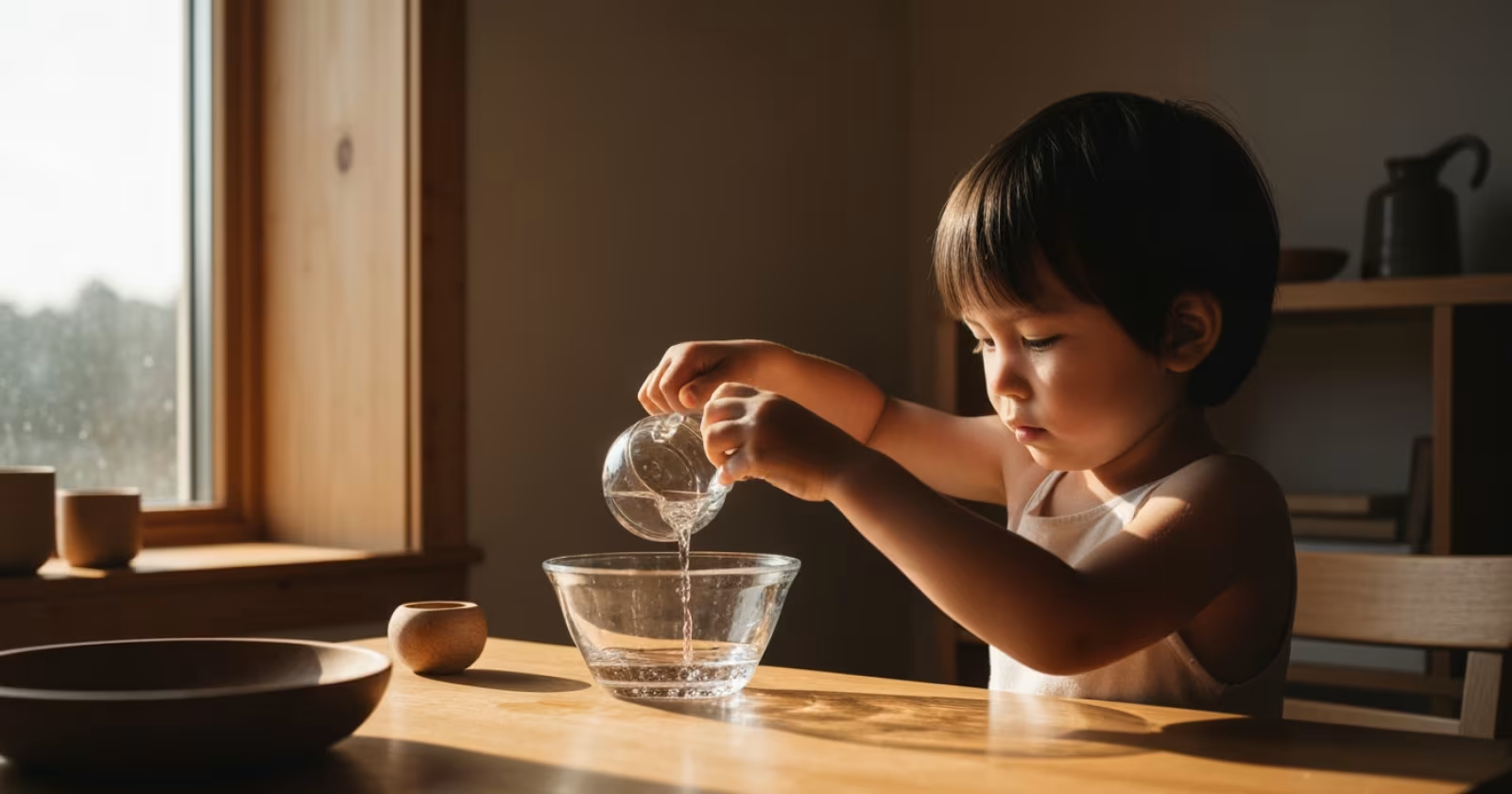
She was sitting on the kitchen floor, trying to pour water from a heavy jug into a small glass. Water spilled everywhere. Your instinct screamed to grab the jug and do it yourself. But something made you pause — and in that pause, she figured it out. Her face lit up like she had conquered the world.
That tiny moment? That is Montessori in action. Not a fancy curriculum. Not expensive wooden toys. Just a deep trust that children are capable of more than we think — if we let them try.
I have spoken to hundreds of parents who feel drawn to Montessori but also confused by it. They wonder if it means letting children do whatever they want, or if it only works in expensive schools. The truth is far simpler, and far more beautiful. Let me walk you through the five core ideas that hold it all together.
Respect for the Child Comes First
The entire Montessori philosophy rests on one radical belief: a child is not an incomplete adult. They are a full human being right now — with their own thoughts, pace, and dignity. Maria Montessori, the Italian physician who developed this approach over a century ago, observed that when adults treat children with genuine respect, something shifts. Children become calmer, more focused, and deeply motivated from within.
Think about how we talk to children at home. “Hurry up.” “Don’t touch that.” “Because I said so.” None of these are terrible on their own. But when they become the dominant tone, a child starts to feel like their world is controlled entirely by someone else. Montessori asks us to flip this — to speak to children the way we would speak to someone we respect deeply, even when we are setting a boundary.
When a child feels respected, they don’t need to fight for power — they can focus all their energy on learning and growing.
This doesn’t mean no rules. It means we explain the reason behind a rule. We offer choices where possible. We kneel down to their eye level when we talk. These small shifts change the entire dynamic between parent and child.
Why Children Learn Best When They Lead
The second principle is child-led learning, and it is probably the most misunderstood one. It does not mean a child decides to eat chocolate for dinner. It means we observe what a child is naturally drawn to — and then we support that interest with the right materials and environment.
Maria Montessori discovered what she called “sensitive periods.” These are windows of time when a child’s brain is wired to absorb a particular skill — language, movement, order, tiny details. You have probably seen this without knowing the term. A toddler who insists on lining up shoes perfectly is in a sensitive period for order. A three-year-old who asks “why” four hundred times a day is deep in a sensitive period for language.
- Sensitive period for movement — typically strongest between ages 1 and 4
- Sensitive period for language — from birth through about age 6
- Sensitive period for order — usually peaks between ages 2 and 3
- Sensitive period for small objects and details — around ages 1 to 3
- Sensitive period for social learning — grows stronger after age 3
When we force a child to focus on something that does not match their current sensitive period, learning feels like dragging a heavy stone uphill. But when we align with their natural rhythm, they learn almost effortlessly. This is what Montessori called “auto-education” — the child teaches themselves when the conditions are right.
| Montessori Principle | What It Looks Like at Home |
|---|---|
| Respect for the Child | Offering choices, speaking calmly, explaining reasons |
| Child-Led Learning | Following your child’s interests instead of forcing a schedule |
| The Prepared Environment | Low shelves, accessible materials, child-sized furniture |
| Hands-On Learning | Real tasks like pouring, folding, cooking together |
| Intrinsic Motivation | Praising effort and process, not just results |
The Environment Is the Silent Teacher
The third principle is what Montessori educators call the “prepared environment.” It sounds formal, but the idea is simple. A child’s surroundings should be designed for the child — not for the adult’s convenience.
At home, this means putting things within a child’s reach. A low hook for their jacket. A small stool near the kitchen counter. Books placed on a shelf they can browse without asking for help. When a child can access their own world independently, they practice decision-making dozens of times a day without any formal lesson.
The prepared environment also means reducing clutter. Too many toys overwhelm a child. Montessori homes often rotate a small number of activities rather than displaying everything at once. This helps children focus more deeply on fewer things — a skill that serves them for the rest of their lives.
How to Bring These Principles Into Your Daily Life
You do not need to overhaul your home or enroll in a special school. These ideas can be woven into ordinary moments, starting today.
Slow down and observe before you intervene. Next time your child struggles with a task — buttoning a shirt, building a tower — wait ten seconds longer than feels comfortable. Watch what they do. Often, they find their own solution. And that solution teaches them far more than your help would have.
Replace “good job” with something specific. Instead of generic praise, try: “You poured the water all by yourself” or “I noticed you kept trying even when it was hard.” This builds intrinsic motivation — the child learns to feel proud of their own effort, rather than performing for applause.
Create one independent station in your home. It could be a snack drawer they can open themselves, a water pitcher at their height, or a shelf with three to four activities they can choose freely. Start small. One station is enough to shift the dynamic.
- Let your child dress themselves — even if the outfit does not match
- Involve them in real household work: folding napkins, watering plants, sorting laundry
- When they ask a question, resist answering immediately — ask “What do you think?” first
- Offer two acceptable choices instead of giving commands: “Would you like to brush teeth first or put on pajamas first?”
Use mixed-age interactions when possible. Montessori classrooms intentionally mix ages so younger children learn from older ones, and older children reinforce their knowledge by teaching. At home, this might look like letting siblings work together on a task, or arranging playdates with children of different ages rather than always the same peer group.
Protect uninterrupted time. When your child is deeply focused on something — even if it looks like “just” stacking blocks — resist the urge to interrupt with a snack or a transition. Deep concentration is one of the most valuable things a young brain can practice. Guard it like the treasure it is.
None of these steps require perfection. You will forget. You will lose patience and grab the jug yourself some mornings. That is completely fine.
What matters is the direction, not the consistency. Every time you pause and let your child try, every time you speak to them like a capable person, you are planting something that grows quietly beneath the surface.
The real gift of Montessori is not a method — it is a way of seeing your child as they already are, whole and capable, even on the messiest days.