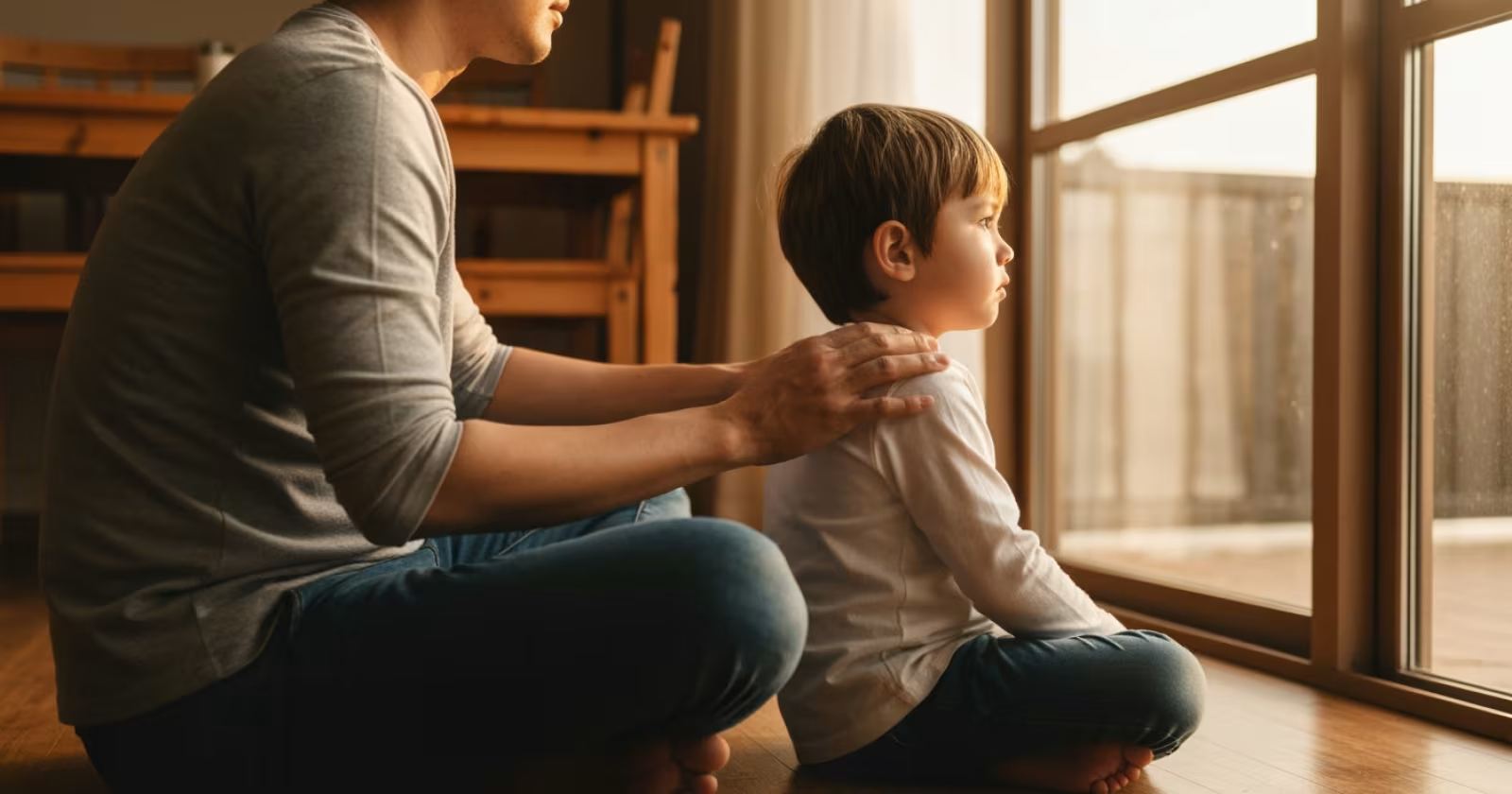
The admission forms are spread across the dining table. Two schools. Two completely different philosophies. Your partner likes one, your mother-in-law swears by the other, and you’re lying awake at 1 AM wondering if one wrong choice will shape your child’s entire future.
That weight you feel? It’s real. Choosing a school isn’t just about academics. It’s about the kind of childhood your child will have — the way they’ll feel about learning, about themselves, about the world. And when the two biggest options look nothing alike, the confusion can feel paralyzing.
But here’s the thing most comparison articles won’t tell you — this isn’t really about which system is “better.” It’s about which one fits your specific child. Let me walk you through what that actually means.
The Real Difference Isn’t What You Think
Most parents assume Montessori means “free play” and traditional means “strict discipline.” Neither is true. The core difference is about who leads the learning — the child or the teacher.
In a Montessori classroom, a child chooses what to work on from a set of carefully designed materials. A four-year-old might spend forty-five minutes pouring water between containers — and that’s considered meaningful work. The teacher observes, guides, and steps in only when needed. Learning happens through touch, movement, and self-correction.
In a traditional classroom, the teacher leads. Everyone learns the same subject at the same time. There are textbooks, tests, and a clear structure. The child knows exactly what’s expected each day. For many children, that predictability feels safe and grounding.
The best school for your child isn’t the one with the best reputation — it’s the one where your child’s specific way of learning is seen and respected.
A parent I know once moved her son from a traditional school to Montessori because she loved the philosophy. Within months, her son was anxious and lost. He needed clear instructions. He thrived on routine. She moved him back — and he blossomed. That doesn’t mean Montessori failed. It means her child needed something different.
Why This Decision Feels So Heavy
School choice triggers a deep fear in parents — the fear of getting it wrong during the years that matter most. And both sides have passionate advocates who can make the other option sound harmful. That noise makes everything harder.
Here’s what child development research actually tells us. Children between ages 3 and 6 are in what Maria Montessori called “sensitive periods” — windows where they naturally absorb certain skills like language, order, and sensory experiences. Both Montessori and traditional systems can support these periods, just through different methods.
What matters more than the label on the school is the emotional environment inside it. A warm, responsive traditional classroom will always outperform a rigid, neglectful Montessori one — and vice versa.
- Children who are naturally curious and self-motivated often thrive in Montessori’s open structure
- Children who feel secure with clear expectations may do better in traditional settings
- Highly social children sometimes benefit from Montessori’s mixed-age classrooms, which encourage mentoring
- Children with attention difficulties may need the external structure that traditional schools provide
- Creative, hands-on learners often light up in Montessori’s material-based approach
None of these are rules. They’re starting points. Your child might surprise you — children often do.
A Side-by-Side Look at What Each Offers
Sometimes it helps to see the differences laid out simply. This table isn’t about scoring — it’s about clarity.
| Aspect | Montessori Approach | Traditional Approach |
|---|---|---|
| Pace of learning | Child-led, individual pace | Teacher-led, group pace |
| Classroom setup | Mixed-age groups (3-year spans) | Same-age groups |
| Assessment | Observation-based, no grades in early years | Tests, grades, report cards |
| Teacher’s role | Guide and observer | Instructor and evaluator |
| Materials | Hands-on, self-correcting tools | Textbooks, worksheets, board work |
| Daily structure | Long uninterrupted work blocks | Fixed periods for each subject |
| Social learning | Collaborative, peer teaching | Structured group activities |
Neither column is inherently superior. Each serves a different kind of learner and a different family’s values.
How to Actually Make This Choice Without Losing Sleep
Watch your child before you research schools. Spend a week simply observing. Does your child create their own games or ask you to tell them what to play? Do they get frustrated without instructions, or frustrated with too many? Their natural tendencies are your best guide.
Visit the actual classroom, not just the website. A Montessori school that looks beautiful online might feel cold in person. A traditional school with an outdated website might have the warmest, most attentive teachers. Sit in for a session if they allow it. Watch the children’s faces — not the décor.
Ask the teacher one specific question: “What do you do when a child is struggling and doesn’t want to participate?” The answer will reveal more about the school’s philosophy than any brochure. You want to hear empathy, patience, and flexibility — regardless of the system.
Talk to parents whose children have been there for at least two years. First-year parents are still in the honeymoon phase. You want honest feedback from families who’ve seen how the school handles challenges, transitions, and difficult phases.
Give yourself permission to change course. Choosing a school at age 3 doesn’t lock your child into a path forever. Many children switch between systems and adjust beautifully. The pressure to “get it right the first time” is mostly in our heads. Children are far more adaptable than we give them credit for.
Check your own anxiety at the door. Sometimes we choose a school to soothe our own fears — about competition, about falling behind, about what relatives will think. Try to separate what your child needs from what your worry is telling you.
What No One Tells You About Either System
Montessori can be challenging for parents who are used to seeing measurable progress. There are no star charts on the wall, no weekly test scores to track. If you need visible proof that your child is learning, the Montessori approach might feel unsettling at first — even if your child is thriving.
Traditional schools can be challenging for children who process things slowly or differently. The pace is set by the curriculum, not the child. A sensitive child who needs more time to absorb concepts might feel rushed — not because the teacher is unkind, but because the system wasn’t designed for individual pacing.
Both systems have excellent schools and mediocre ones. The label matters far less than the humans running the classroom.
There is no perfect school. There is only the school where your child feels safe enough to be curious, make mistakes, and try again. Where they come home tired but not broken. Where they talk about what they learned — not because they were told to, but because something sparked inside them.
Trust what you see in your child’s eyes when they come home. That will always tell you more than any philosophy ever could.